Resistance bands are one of the most underrated pieces of home fitness equipment, and for this particular audience, they may be the single best place to start. They’re inexpensive, take up almost no space, and carry a lower injury risk than free weights while still providing genuine, measurable strength benefits. Here’s what to actually look for.
Do Resistance Bands Really Work as Well as Weights?
It’s a fair question, given how much marketing around fitness equipment overstates benefits. The research here is genuinely reassuring. A randomized controlled trial comparing elastic band training to free weight training in older adults found meaningful strength improvements in both groups, with researchers concluding that elastic resistance training is not only effective but also a safe, cost-effective option for older adults specifically. Other research reviewing multiple studies has similarly found that resistance bands can produce strength gains comparable to conventional resistance training across a range of populations and program designs.
This doesn’t mean bands and weights are interchangeable in every situation, since bands provide a distinctive resistance curve that increases as the band stretches rather than staying constant like a dumbbell. But for building general strength, especially for someone newer to training, that difference matters far less than simply training consistently with progressive resistance, which bands support well.
Types of Resistance Bands
| Type | What It’s Good For | Considerations |
|---|---|---|
| Loop bands (mini bands) | Lower-body exercises, glute and hip work, warm-ups | Compact, but limited for upper-body exercises |
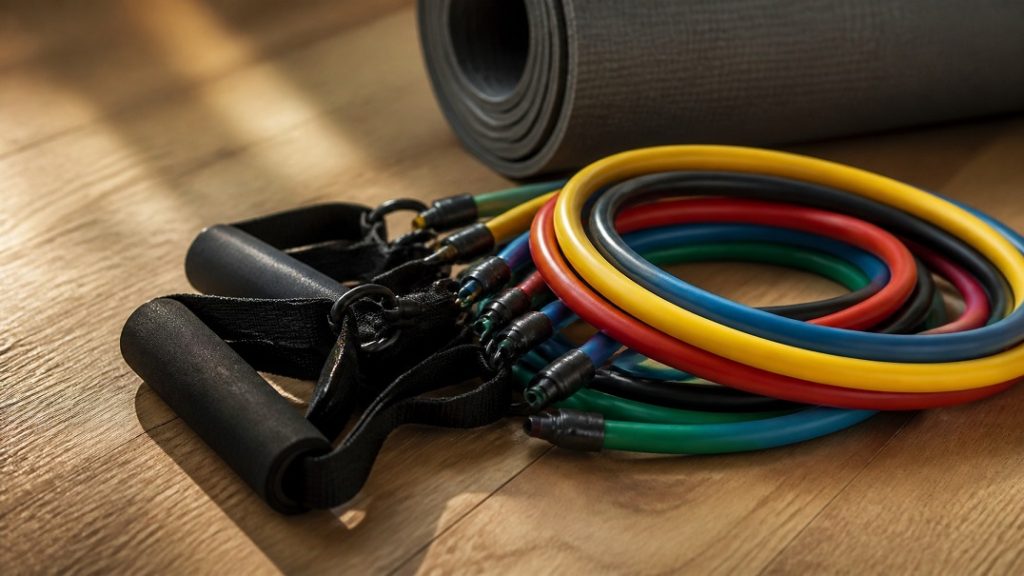
| Tube bands with handles | Full-body strength exercises, rows, presses, curls | Handles improve grip comfort, especially useful if grip strength is limited |
| Flat bands (therapy bands) | Rehabilitation-style exercises, gentle strengthening | Often lower resistance overall; a good starting point for beginners |
| Figure-8 bands | Compact upper-body exercises | Less versatile than tube bands; a secondary option rather than a first purchase |
For most people starting out, a set of tube bands with handles offers the best combination of versatility and comfort, since the handles reduce strain on the hands during exercises like rows and presses.
Understanding Resistance Levels
Bands are typically labeled by resistance level, often color-coded, ranging from extra light to extra heavy, though the exact resistance behind each color varies by manufacturer. Rather than trying to match a specific color to a specific weight equivalent, it’s more useful to think in terms of how a band feels for a specific exercise. A band that allows 12 to 15 controlled repetitions with noticeable effort by the final few reps is in a reasonable working range for that exercise; a band you can do 25 or more repetitions with easily is too light to keep driving progress.
Buying a Range, Not Just One Band
Because a single resistance level rarely suits every exercise, a starter set spanning three to five resistance levels tends to be more useful than a single band. Upper-body exercises like bicep curls generally require less resistance than lower-body exercises like squats or leg presses, so having a range allows you to match the right resistance to each movement rather than compromising on one band for everything.
Features Worth Prioritizing
Handles and Grip Comfort
If grip strength is a concern, look for bands with padded, secure handles rather than plain tubing you hold directly. This reduces strain on the hands and makes it easier to maintain proper form throughout a set, particularly during fatiguing repetitions.
Door Anchors
A door anchor, a simple strap that wedges into a door frame, dramatically expands the range of exercises available with a band, allowing for rows, presses, and other movements that require an anchor point. This is a low-cost add-on worth including in an initial purchase.
Durability and Material Quality
Bands made from natural latex generally offer better durability and elasticity than cheaper synthetic alternatives, though latex allergies are a consideration for some people, in which case latex-free options are available. Regardless of material, inspect bands periodically for small tears, thinning, or discoloration, since a band that snaps under tension can cause injury.
Ankle Straps
For anyone incorporating hip and leg exercises, particularly those covered in balance and fall-prevention training, a padded ankle strap accessory makes band-based leg exercises considerably more comfortable than looping a band directly around the ankle.
Safety Tips Specific to Bands
Bands carry a different set of risks than free weights. The most common issue is a band slipping out of position or snapping, usually due to overstretching beyond the band’s rated capacity or gripping with wet or sweaty hands. Avoid stretching a band beyond about two and a half times its resting length, keep bands away from sharp edges or jewelry that could nick the material, and replace any band showing visible wear rather than continuing to use it past its useful life. None of these precautions are complicated, but they’re worth building into your routine from the start.
Bands vs. Weights: When Each Makes More Sense
While the research shows bands and weights can produce comparable strength gains, that doesn’t mean the choice is arbitrary. Bands tend to make more sense as a starting point for a few practical reasons: they’re gentler on joints during the lengthening portion of a movement, they’re far less expensive for an equivalent range of resistance, and they take up virtually no storage space compared to a rack of dumbbells. Weights, on the other hand, tend to make more sense once you want very precise, repeatable resistance from session to session, since a band’s resistance can vary slightly depending on how it’s anchored or stretched. Many people end up using both, bands for certain exercises and joint-friendly warm-ups, dumbbells for others, rather than treating the choice as strictly either-or.
A Reasonable Starter Setup
For most people beginning strength training with bands, a practical starting purchase includes a set of three to five tube bands with handles spanning light to heavy resistance, a door anchor, and a padded ankle strap. This combination supports the vast majority of upper- and lower-body exercises covered in a typical beginner strength routine and is inexpensive enough to be a low-risk first investment in home strength equipment.
Where to Go From Here
For specific exercises that pair well with resistance bands, see bodyweight and resistance-band routines for home, no gym needed. Once bands start feeling too easy across the board, adjustable dumbbells worth buying for home use covers the next logical equipment upgrade.