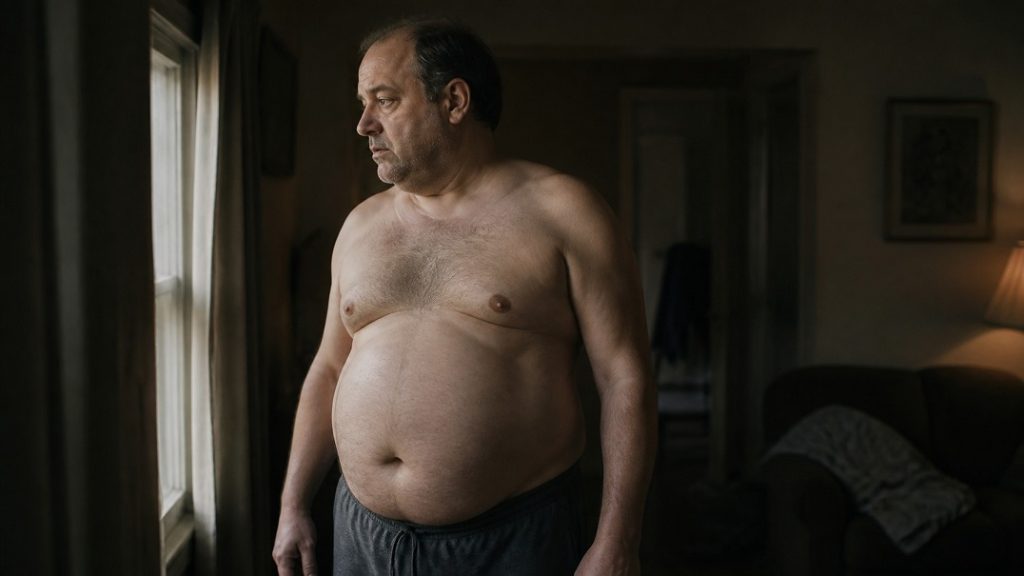
Most people assume that losing muscle would show up clearly on a bathroom scale, probably as a drop in weight. For a meaningful number of people, that is not what happens at all. Instead, muscle quietly declines while body fat holds steady or even increases, leaving the number on the scale essentially unchanged, or even higher than it used to be. This pattern has a name, sarcopenic obesity, and it is one of the more easily missed forms of age-related muscle loss precisely because it does not look the way people expect.
What Sarcopenic Obesity Actually Means
Sarcopenic obesity describes the combination of reduced muscle mass and strength alongside excess body fat. It is not about total weight, and it is not necessarily about meeting a standard clinical definition of obesity by body mass index. What matters is the underlying ratio and distribution: muscle is declining, fat is stable or rising, and the two changes are happening at the same time in the same person.
This combination can occur in people who would not necessarily be described as overweight in casual conversation. A person of average or even below-average weight can have a body composition that qualifies, if their proportion of fat to muscle has shifted enough.
Why This Pattern Is Easy to Miss
The Scale Tells an Incomplete Story
Body weight is simply a total, and a total can stay flat even while its two major components move in opposite directions. If someone loses four pounds of muscle over a year while gaining four pounds of fat, the scale shows no change at all, even though a meaningful shift in body composition has taken place. This is part of why relying on weight alone, without any sense of body composition, can leave sarcopenic obesity completely invisible for years.
Appearance Can Be Misleading Too
Clothing size and general appearance can also stay fairly stable through this process, especially if fat is being gained in areas that are not immediately obvious, or if a slightly looser, softer look gets attributed simply to normal aging rather than an actual compositional shift. Many people with sarcopenic obesity do not look particularly heavy or particularly thin. They often look like an average, ordinary older adult, which is exactly the problem.
How Sarcopenic Obesity Develops
Several factors tend to feed into this pattern, often at the same time.
Reduced Activity Combined With Stable Eating Habits
As physical activity declines with age, particularly resistance-based activity, the body needs less energy to maintain itself, but eating habits do not always adjust to match. The result is a slow accumulation of fat even as muscle, which requires ongoing use to maintain, gradually shrinks from disuse.
Hormonal Changes
Age-related shifts in hormones such as estrogen, testosterone, and growth hormone affect both muscle maintenance and fat distribution, often in ways that favor fat storage, particularly around the midsection, while making it harder to maintain existing muscle.
Inflammation
Excess body fat, particularly visceral fat around the abdominal organs, produces inflammatory signals that can actively interfere with muscle maintenance. This creates a cycle where fat gain contributes to muscle loss, and muscle loss makes it easier for fat to continue accumulating, since less muscle means fewer calories burned at rest.
Why the Combination Carries Extra Risk
Research on this topic, including a review published in Nutrients, has suggested that sarcopenic obesity is associated with a higher risk of mobility limitations and metabolic issues than either muscle loss or excess fat alone. The two conditions appear to reinforce each other rather than simply adding together, which is part of why researchers treat the combination as its own distinct concern rather than just two separate issues happening to occur in the same person.
How Sarcopenic Obesity Is Identified
Because weight and BMI are unreliable indicators here, identifying sarcopenic obesity typically requires a more direct look at body composition. A DEXA scan can measure muscle mass and fat mass separately, giving a much clearer picture than weight alone. Grip strength testing and physical performance tests, similar to those used in standard sarcopenia evaluation, are also commonly used alongside a body composition measurement, since strength and function matter as much as the numbers themselves.
| Measurement | What It Reveals |
|---|---|
| Body weight or BMI alone | Often normal or unchanged, unreliable on its own |
| DEXA scan | Separates muscle mass from fat mass directly |
| Grip strength test | Reveals functional strength regardless of body weight |
| Waist circumference | Can flag increasing central fat even at stable weight |
What Helps Address Sarcopenic Obesity
The approach that tends to work best addresses both sides of the equation at once rather than focusing purely on weight loss or purely on muscle building. Resistance training is particularly important here, since it directly targets the muscle side of the equation while also supporting a more favorable metabolic environment. Attention to adequate protein intake matters as well, since weight loss efforts that are not paired with enough protein and resistance exercise can sometimes make the muscle side of this equation worse rather than better, even while total weight goes down.
A gradual approach tends to work better than an aggressive one. Rapid, large calorie deficits are more likely to pull from muscle stores as well as fat, particularly without a strong resistance training stimulus to signal the body to preserve muscle. A more moderate pace of change, paired with consistent strength training and enough protein at each meal, tends to shift body composition in the right direction rather than simply lowering the number on the scale while leaving the underlying muscle-to-fat ratio unchanged.
Where to Go From Here
If your weight has stayed fairly stable but you have noticed reduced strength, looser muscle tone, or a slowly increasing waistline, sarcopenic obesity is worth considering as a possibility rather than assuming the scale is telling you everything you need to know. Our guide to how sarcopenia is diagnosed covers the testing options in more detail, and our breakdown of protein needs after 50 is a useful next step for addressing the muscle side of this pattern directly.


