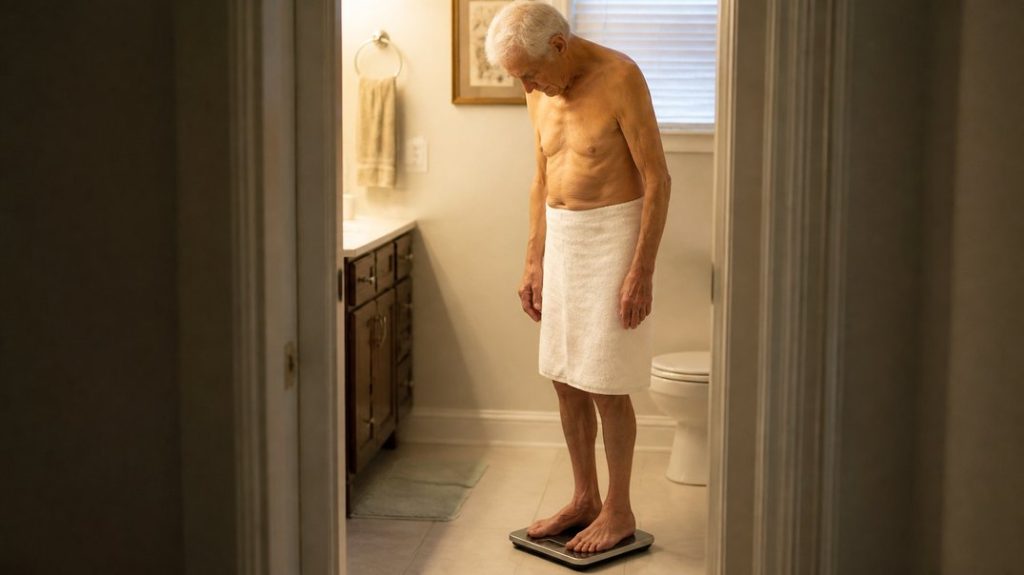
Muscle loss and mood are linked, and the connection runs through everyday life: weaker people often do less, go out less, and feel less sure of themselves. Studies find that people with low muscle mass are more likely to have depression symptoms, and that stronger people tend to report fewer. Researchers are still sorting out cause and effect, but strength is something you can work on, and that is encouraging.
What Research Shows About Sarcopenia and Depression
A 2025 systematic review in Frontiers in Public Health pooled data from more than 30 studies, including 34,029 people in its main analysis. It found that sarcopenia was associated with higher odds of depression, with an adjusted odds ratio of 1.49. In plain terms, people with low muscle mass and strength were about one and a half times as likely to have depression as those without it.
There is an important limit. Every study in the review was a snapshot, which means it measured both conditions at one point in time. Snapshots cannot show which problem came first. The authors describe the relationship as possibly two-way and call for more research on the mechanisms. Most of the studies also used screening questionnaires rather than formal diagnoses, so the numbers describe symptoms, not clinical depression.
What Strength and Mood Studies Add
A 2020 meta-analysis of 21 studies covering 87,508 adults in 26 countries looked at muscular strength and depression symptoms. When the reviewers pooled nine observational studies, lower strength was linked to more depressive symptoms. The trials were mixed. One found that strength and aerobic training both reduced symptoms in older adults with major depression, while another found no meaningful difference between strength training and relaxation training.
Strength in these studies was mostly measured with handgrip, and not every study agreed. One observational study found no association at all, which is typical when researchers study mood, because depression has many causes beyond muscle. The authors suggested that strength training might help promote mental health, while the mostly observational evidence means that idea is promising rather than proven. It is a reasonable reason to try, though, since strength training has many other benefits for older adults.
Loneliness, Isolation, and Muscle
Confidence also depends on connection. A Chinese study of 7,970 adults aged 45 and older who began without sarcopenia followed them for four years, and 305 developed it. Loneliness was linked to higher odds of new sarcopenia (odds ratio 1.27), and loneliness together with social isolation was linked to 1.67. The authors state that no definitive causal conclusions can be drawn.
It is easy to see how the cycle could work. Weakness can make outings feel risky or tiring, so people stay home, see fewer friends, and move less. The good news is that the cycle can be interrupted at several points, and exercise is one of the easiest to reach.
Practical Ways to Rebuild Strength and Confidence
Start with goals small enough to finish. A short chair-based routine, a walk with a neighbor, or a weekly class gives you a win and a reason to leave the house. Our guide to realistic strength goals shows how to set targets you can reach, and our post on living well with sarcopenia covers day-to-day strategies.
If sadness, loss of interest, or withdrawal lasts for weeks, tell your doctor. Low mood is treatable, and your doctor can look at mood and strength together. Our guide to when to talk to your doctor can help you prepare for that conversation.
Quick Answers
Can Low Muscle Strength Cause Depression?
Studies show a link, but most are snapshots that cannot prove which problem comes first. The relationship may run in both directions.
Can Strength Training Improve Mood?
Some trials in older adults with depression found that strength training reduced symptoms, while another found no difference from relaxation training. The evidence is promising but mixed.
When Should I Talk to My Doctor About Low Mood?
Tell your doctor if sadness, loss of interest, or withdrawal lasts for weeks or interferes with daily life. They can check both mood and strength.