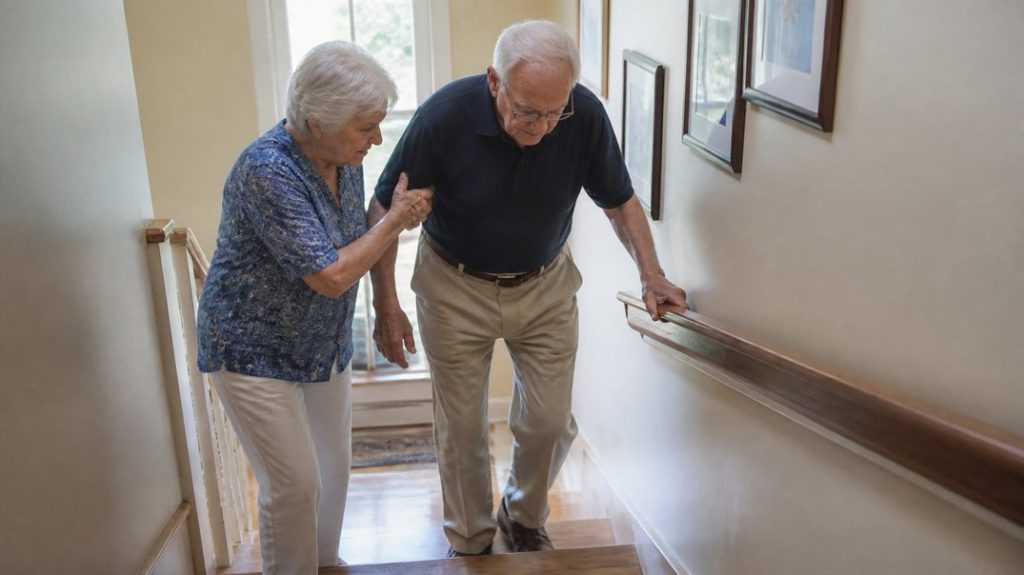
How does fear of falling lead to more weakness? Avoiding activity weakens muscles. Learn how balance and mind-body exercise can break the cycle.
Fear of falling can start a loop: you cut back on walking, stairs, and outings to stay safe, less activity makes your muscles weaker, and weaker muscles make a fall more likely. The loop is breakable. Balance work, mind-body exercise such as tai chi, and confidence-building programs are among the best-supported ways to ease the fear and keep you moving.
How the Fear-of-Falling Loop Starts
A 12-month study of adults aged 75 and older in England followed 543 people who were not limiting their activities at the start. By the end, 55 of them (10.1 percent) had started staying home or going out less because of concerns about falling. Greater frailty, a fall during the year, and slower Timed Up and Go times all predicted who would cut back.
The authors point out that not everyone who worries about falling restricts activity, so the fear itself is not destiny. They recommend that people who are at risk be directed to balance exercise and services that address concern about falling.
Why Less Activity Means Weaker Muscles
No study here proves that fear of falling directly shrinks muscle, but research on reduced activity shows what happens when movement drops. A 2019 review in Frontiers in Nutrition reports that muscle mass declines about 1 percent a year after age 60 and strength about 3 percent a year, and that periods of inactivity can speed this up. In older adults who cut their steps to 750 to 1,500 a day, muscle protein synthesis fell 13 to 26 percent, and knee strength dropped 6 to 9 percent in some studies, with recovery incomplete or absent.
Even short breaks matter. In a small trial of 17 healthy adults averaging 68 years old, seven days of bed rest reduced knee strength by 12 percent, and a daily 2,000-step walk did not prevent that loss. The lesson is that avoiding activity costs strength surprisingly fast, which is why restarting early is worth the effort.
How to Break the Loop
An umbrella review of 25 reviews in adults aged 60 and over concluded that holistic exercises such as tai chi, yoga, and Pilates were the most effective for reducing fear of falling. Combined physical and cognitive approaches were also described as effective, although the authors say longer studies are needed to confirm that the benefits last. The 12-month study above also cites an earlier trial in which a multicomponent cognitive behavioral group program reduced both fear of falling and activity avoidance.
Strength helps directly, too. In one study cited in the review above, older adults did low-load leg exercises three times a week during two weeks of reduced activity, and the trained leg was protected against the drop in muscle protein synthesis. Our guide to balance training for fall prevention explains where to begin.
Start Where You Feel Safe
Confidence grows from small successes. Begin with exercises you can do while holding a counter or sitting in a sturdy chair, such as those in our post on chair-based exercises, and progress as your balance improves. A physical therapist can set a safe starting point, especially if you have fallen before. Our overview of balance, falls, and independence covers how to protect your freedom at home.
Quick Answers
How Common Is Restricting Activity Because of Fear of Falling?
In a study of adults aged 75 and older, about 1 in 10 (10.1 percent) who were not restricting activity at the start had begun doing so within a year.
What Exercise Helps Reduce Fear of Falling?
An umbrella review of 25 reviews found that mind-body exercises such as tai chi, yoga, and Pilates were the most effective.
Can Strength Come Back After Avoiding Activity?
Training helps, but in some studies recovery after inactivity was incomplete. That is a good reason to start moving again sooner rather than later.