You don’t need a clinic visit to get a meaningful read on your own strength and muscle health. A few inexpensive tools, a hand dynamometer, a body composition scale, and even a basic tape measure, can give you real, trackable data at home, letting you see whether your training and nutrition efforts are actually working rather than relying on how you feel on any given day.
Hand Dynamometers
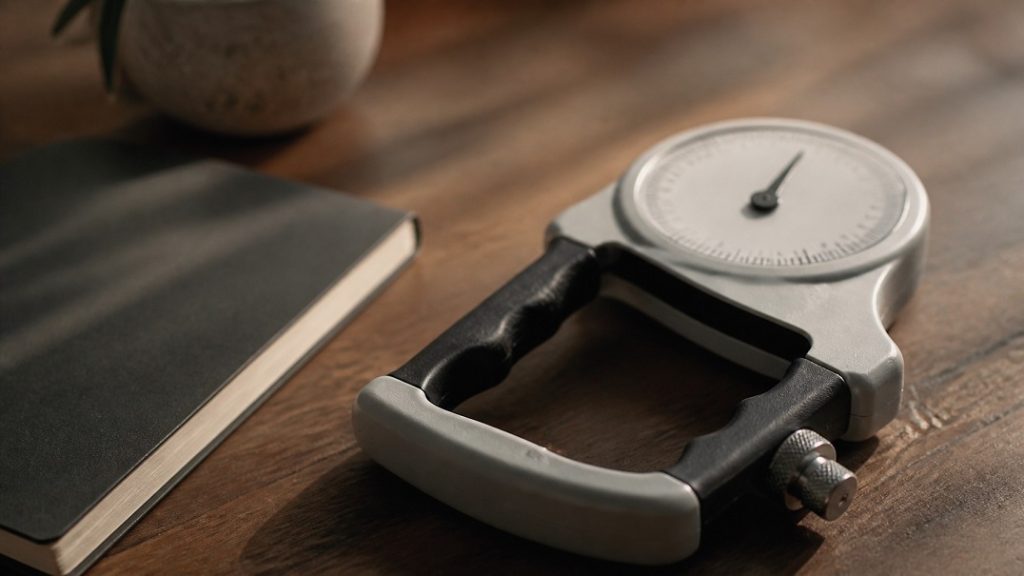
A hand dynamometer measures grip strength, one of the most studied and clinically meaningful indicators of overall muscle health available. As covered in simple home tests to track your own strength, grip strength correlates strongly with whole-body strength and is directly used in diagnosing sarcopenia.
What to Look for in a Home Dynamometer
| Feature | Why It Matters |
|---|---|
| Adjustable handle width | A properly fitted grip position produces more consistent, comparable readings across sessions |
| Clear, easy-to-read display | Analog dials can be harder to read precisely than a digital display |
| Appropriate measurement range | Make sure the device’s range comfortably covers typical adult grip strength, generally up to at least 90 pounds |
| Consistent, repeatable calibration | A device that gives wildly different readings on back-to-back tests of the same grip is not useful for tracking trends |
A home dynamometer doesn’t need to match the precision of a hospital-grade clinical device to be useful. What matters most for personal tracking is consistency: using the same device, the same hand position, and a similar testing routine each time, so that a change in your reading over months actually reflects a change in your strength rather than measurement noise.
Body Composition Scales
Some home scales go beyond simple weight and estimate body composition metrics like muscle mass and body fat percentage using a technology called bioelectrical impedance, which sends a very mild electrical signal through the body and estimates composition based on how tissues conduct it.
What These Scales Can and Can’t Tell You
It’s worth having realistic expectations here. Consumer body composition scales provide an estimate, not a precise measurement, and that estimate can shift noticeably based on hydration status, recent food intake, and even time of day. A single reading shouldn’t be treated as an exact number. Where these scales do provide genuine value is in tracking a general trend over months, weighing in at a similar time of day under similar conditions, since the same margin of error tends to apply consistently, which makes the direction of change more meaningful than any single data point.
Features Worth Considering
- An app that logs readings over time and displays trends, rather than requiring you to manually record each reading.
- Support for multiple user profiles if more than one household member will use the scale.
- A stated accuracy range or validation study from the manufacturer, which not all budget scales provide but is a reasonable thing to look for.
Tape Measures: The Simplest, Most Accessible Tool
It’s easy to overlook a basic tape measure as a legitimate tracking tool, but calf circumference specifically has real diagnostic relevance. Research supporting sarcopenia screening guidelines from the Asian Working Group for Sarcopenia uses calf circumference cutoffs, generally below about 34 centimeters (roughly 13.4 inches) for men and 33 centimeters (roughly 13 inches) for women, as an indicator worth further evaluation, since calf circumference correlates with overall muscle mass.
How to Measure Calf Circumference Consistently
Sit with your knee bent at roughly a 90-degree angle and your foot flat on the floor. Wrap a flexible, non-stretch tape measure around the widest part of your calf without compressing the skin or underlying tissue, and record the measurement in the same position each time you check it. Measuring both calves and using the larger of the two readings is the approach used in most research protocols.
Why This Simple Measurement Has Real Value
Unlike a dynamometer or a body composition scale, a tape measure costs only a few dollars and requires no calibration or batteries, making it one of the most accessible tracking tools available. While it shouldn’t be treated as a replacement for a proper sarcopenia screening by a doctor, tracking calf circumference alongside your other measurements provides an additional, low-cost data point that’s grounded in actual research rather than guesswork.
Building a Simple Tracking Routine
Rather than testing everything constantly, a reasonable approach is to check grip strength and calf circumference every 8 to 12 weeks, similar to the timeline recommended for the chair-stand test covered elsewhere on this site, and to weigh in on a body composition scale, if you have one, under consistent conditions on a similar schedule. Recording all of these in one simple log, alongside functional notes about how daily tasks feel, gives you a well-rounded picture without requiring daily measurement or excessive attention to normal short-term fluctuation.
Interpreting Your Numbers Without Overreacting
One of the more common pitfalls with home tracking tools is treating every single reading as a verdict rather than a data point. Grip strength can vary by several pounds from one session to the next depending on time of day, recent activity, and even how warmed up your hands are. A body composition scale reading can shift by a percentage point or two overnight based on hydration alone. Calf circumference is more stable day to day but can still fluctuate slightly with fluid retention. The way to use these tools well is to focus on the trend across several measurements spaced weeks apart, rather than reacting strongly to any single number that looks worse or better than expected. If a concerning trend does show up consistently across three or more measurements over a couple of months, that’s a meaningful signal worth discussing with a doctor, unlike a single unusual reading.
A Reasonable Starting Point
If you’re building a home tracking toolkit from scratch, a tape measure costs almost nothing and is worth having regardless of what else you buy. A hand dynamometer is a worthwhile next addition given how directly grip strength ties to overall muscle health. A body composition scale is a reasonable, optional third tool for anyone who wants an additional trend line to track, though it’s the least essential of the three for someone working within a limited budget.
Where to Go From Here
For the full testing protocol these tools support, including the chair-stand test, see simple home tests to track your own strength. To turn your tracking data into meaningful goals, setting realistic strength goals after 50 covers how to pair measurement with a specific, motivating target.