You don’t need a gym membership or a doctor’s referral to find out whether your strength is holding steady, improving, or slipping. A handful of simple, well-studied tests can be done in your living room in under ten minutes, and repeating them every couple of months gives you real data instead of a vague sense that things feel harder or easier lately.
Why Testing at Home Is Worth the Ten Minutes
Sarcopenia, the age-related loss of muscle mass and strength, tends to progress slowly and quietly. Without some kind of measurement, it’s easy to adjust your habits without noticing, avoiding a certain jar lid or taking the elevator instead of the stairs, until the underlying decline has gone further than you realized. Objective tests cut through that. They also give you something concrete to track when you start a new exercise routine or supplement, so you can tell whether it’s actually working rather than guessing.
Researchers use two measurements more than any others to flag early muscle weakness: grip strength and lower-body function, most often assessed with a sit-to-stand test. Both have been studied extensively enough that we know roughly what “normal” looks like at different ages, which makes them genuinely useful for a home routine.
The 30-Second Chair Stand Test
This test measures lower-body strength and endurance, the same muscles you rely on to get up from a couch, a car seat, or the toilet without pushing off with your arms. It’s part of the CDC’s STEADI fall prevention program, which health care providers use to screen older adults for fall risk.
How to Do It
Sit in the middle of a sturdy, armless chair with your feet flat on the floor and your arms crossed over your chest. Starting from a seated position, stand up fully and then sit back down again, as many times as you can in 30 seconds, without using your arms for help. Count each full stand as one repetition. If you’re more than halfway up when the 30 seconds ends, that counts as a completed repetition.
What the Numbers Mean
There isn’t one single “pass” number, since scores vary by age and sex, but the table below gives a rough sense of average ranges for community-dwelling older adults, based on commonly used reference values.
| Age Range | Typical Range, Women | Typical Range, Men |
|---|---|---|
| 60 to 64 | 12 to 17 | 14 to 19 |
| 65 to 69 | 11 to 16 | 12 to 18 |
| 70 to 74 | 10 to 15 | 12 to 17 |
| 75 to 79 | 10 to 15 | 11 to 17 |
If your result falls noticeably below the range for your age, or if you needed to use your arms to complete even a few repetitions, that’s worth mentioning to your doctor. It’s also a reasonable prompt to revisit your resistance training routine.
Grip Strength: A Surprisingly Powerful Indicator
It might seem odd that squeezing a device with your hand tells researchers much about your overall muscle health, but grip strength is one of the most studied markers in aging research. A large multi-study analysis coordinated by the National Institute on Aging helped establish grip strength cutoffs used to flag clinically relevant weakness, generally below about 57 pounds for men and 35 pounds for women, though individual clinical criteria vary somewhat.
How to Test It
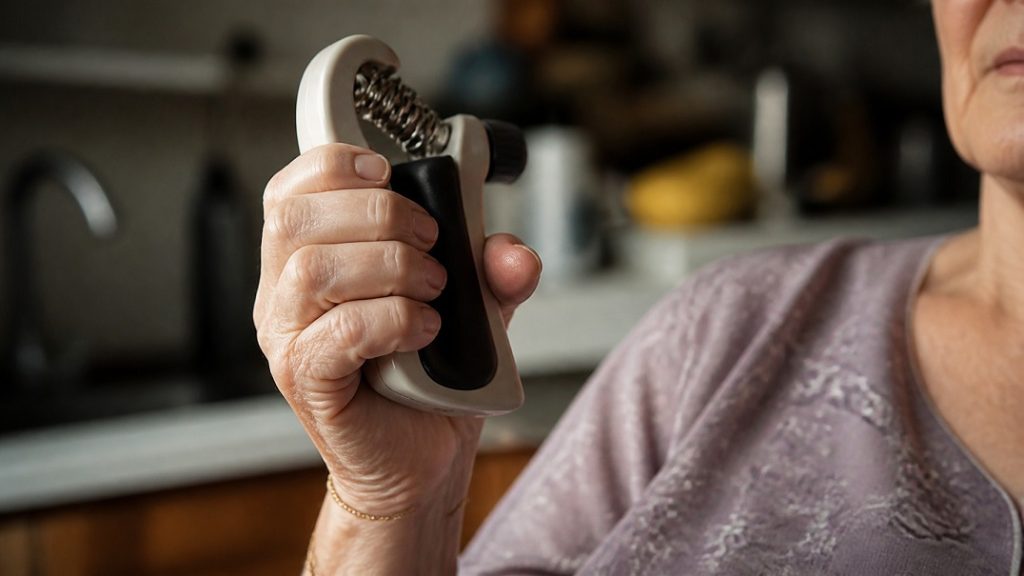
A hand dynamometer, a small handheld device that measures grip force, is the standard tool, and inexpensive versions are widely available online. Sit with your elbow bent at 90 degrees and your arm close to your body, then squeeze the dynamometer as hard as you comfortably can. Test each hand two to three times and record your best result per hand.
Grip strength matters beyond the hands themselves. It correlates strongly with overall muscle strength throughout the body, and low grip strength is associated with a higher risk of falls, fractures, and reduced independence, which is part of why it’s used so widely as a quick screening tool.
A Few Simpler Options If You Don’t Want to Buy Equipment
If a dynamometer isn’t in your budget right now, you still have useful options. Timing how long it takes to walk a fixed distance, such as the length of a hallway, gives a rough read on overall function. Counting how many times you can rise from a chair using only one arm for support, rather than none, is a gentler version of the chair-stand test that still tracks progress over time. None of these substitutes are as precise as the standard tests, but consistency matters more than precision when you’re simply looking for trends in your own numbers.
Tracking a Second Dimension: Balance
Strength and balance are closely linked, but they aren’t identical, and it’s worth checking both. The single-leg stance test is a simple add-on: stand near a counter for safety, lift one foot slightly off the floor, and time how long you can hold your balance without touching down or grabbing the counter. Most healthy adults in their 50s and 60s can hold this for at least 10 seconds per side; noticeably shorter times, or a big difference between your left and right side, are worth tracking over time alongside your strength numbers.
Combining a strength measure with a balance measure gives you a more complete picture than either one alone, since some people maintain reasonable strength but develop balance problems first, or the reverse. Testing both every couple of months means you’re less likely to be caught off guard by a change in only one area.
What to Do With a Concerning Result
If a result comes back lower than expected, resist the urge to treat it as a verdict. Retest a few days later to rule out an off day, since sleep, illness, and even dehydration can temporarily affect performance on these tests. If the lower number holds up on a retest, that’s useful information, not a reason for alarm. It tells you where to focus your training and gives you a concrete baseline to measure improvement against. Bringing a written log of your test results to a doctor’s appointment can also make that conversation far more productive than describing symptoms from memory.
Turning Numbers Into a Habit, Not an Obsession
Testing every 8 to 12 weeks strikes a good balance. It’s frequent enough to catch a meaningful trend, either encouraging or concerning, without becoming a source of daily anxiety. Keep a simple log, even just a note on your phone with the date and your numbers, so you can look back and see the trajectory rather than fixating on any single test day, which can be affected by sleep, soreness, or how recently you ate.
Where to Go From Here
Once you have a baseline, it’s worth pairing these numbers with a real strength routine; resistance training basics for people who’ve never lifted weights is a good next stop if you haven’t started one. If your chair-stand numbers point to balance concerns as well as strength concerns, read how strength loss affects balance, falls, and independence for the fuller picture.